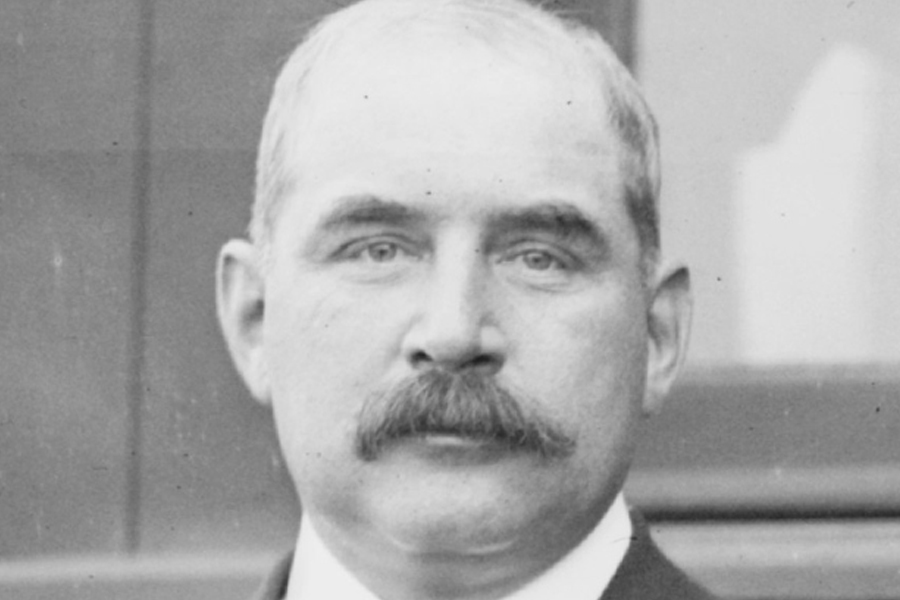
J P Morgan Jr, formally John Pierpont Morgan Jr, was born on September 7, 1867, in Irvington, New York. Known within his family and social circle as Jack, he inherited one of the most influential financial institutions in the United States when his father, J. P. Morgan Sr, died in 1913.
I find his story especially interesting because he lived in the shadow of an extraordinary father while building a career of his own. He was less theatrical and less publicly dominant than J. P. Morgan Sr, yet he presided over the House of Morgan during two turbulent decades that included World War I, the prosperous 1920s, the Wall Street crash of 1929, the Great Depression, and sweeping financial reforms.
His life also reveals how closely banking, family, philanthropy, international affairs, art, and high society were intertwined among America’s wealthiest families in the late 19th and early 20th centuries.
The Early Life of J P Morgan Jr
Jack Morgan was the son of J. P. Morgan Sr and Frances Louisa Tracy Morgan. His father was already becoming a formidable figure in American finance, while his mother came from a well established New York family.
Jack attended St. Paul’s School before entering Harvard College. He later trained in the family banking business in both New York and London. His London experience was particularly important because the Morgan family’s financial network extended across the Atlantic through the firm J. S. Morgan & Co.
Rather than immediately stepping into the spotlight, Jack learned the mechanics of international banking from within the family enterprise. This preparation helped him develop relationships in Britain and continental Europe that later became important during World War I.
He married Jane Norton Grew on December 11, 1890. She came from a prominent Boston family and brought her own connections to the world of banking, business, art, and society.
The Morgan Family
The Morgan family was not simply a banking family. It was connected through marriage, business, philanthropy, education, art, and social institutions to many influential American and British families.
| Family member | Dates | Relationship or role |
|---|---|---|
| J. P. Morgan Sr | 1837 to 1913 | Jack’s father and prominent financier |
| Frances Louisa Tracy Morgan | 1842 to 1924 | Jack’s mother |
| Louisa Pierpont Morgan | 1866 to 1946 | Jack’s sister |
| J. P. Morgan Jr | 1867 to 1943 | Banker and head of J. P. Morgan & Co. |
| Juliet Pierpont Morgan | 1870 to 1952 | Jack’s sister |
| Anne Tracy Morgan | 1873 to 1952 | Jack’s sister and philanthropist |
| Jane Norton Grew Morgan | 1868 to 1925 | Jack’s wife |
| Junius Spencer Morgan III | 1892 to 1960 | Jack’s son |
| Jane Norton Morgan Nichols | 1893 to 1981 | Jack’s daughter |
| Frances Tracy Pennoyer | 1897 to 1989 | Jack’s daughter |
| Henry Sturgis Morgan | 1900 to 1982 | Jack’s son and Morgan Stanley cofounder |
The family connections extended even further through the marriages of Jack’s children. These relationships linked the Morgans with families associated with banking, law, industry, politics, publishing, and the arts.
His Father J P Morgan Sr
The first generation of the House of Morgan was defined by J. P. Morgan Sr. He was one of the most important Gilded Age and early Progressive Era financiers, born in 1837.
Jack inherited his father’s cash and a huge institutional burden.
Differences between father and son matter. J. P. Morgan Sr. was known for personally resolving financial crises. Jack worked elsewhere. He depended on experienced partners and executives after inheriting an established company.
His leadership was consistent, not just like his father’s.
Jane Norton Grew Morgan
Jane Norton Grew was born in 1868 and married Jack Morgan in 1890. Her father, Henry Sturgis Grew, was a Boston banker and mill owner.
Jane was involved in the cultural and social world surrounding the Morgan family. She was also interested in art and horticulture and maintained the family’s connections to elite circles in New York and London.
Her marriage to Jack lasted until her death in 1925. Together they had several children who continued the family’s presence in finance and American society.
The Children of J P Morgan Jr
Jack and Jane Morgan had four surviving children.
Junius Spencer Morgan III
Junius Spencer Morgan III was born in 1892. He married Louise Converse in 1915. His marriage connected the Morgan family with the Converse family, another established New England family.
The Morgan name continued through several branches of descendants, creating a large network of relatives extending into later generations.
Jane Norton Morgan Nichols
Born in 1893, Jane Norton Morgan later married George Nichols, a yachtsman. Like other members of the family, she lived within a social world where sailing, travel, philanthropy, and inherited wealth overlapped.
Frances Tracy Pennoyer
Frances Tracy Morgan was born in 1897 and married lawyer Paul Geddes Pennoyer in 1917.
She maintained a comparatively private life while raising a large family. Her descendants extended the Morgan family network through multiple generations.
Henry Sturgis Morgan
Henry Sturgis Morgan, born in 1900, became one of the most significant members of the next generation.
He later helped establish Morgan Stanley with Harold Stanley. The creation of Morgan Stanley was closely connected to the financial restructuring that followed the Glass Steagall Act of 1933, which separated commercial banking from investment banking.
In this way, Jack Morgan’s son became part of a transformation that changed the institution his father had led.
J P Morgan Jr and World War I
When World War I began in 1914, J. P. Morgan & Co. became deeply involved in Allied purchasing and financing.
The firm served as a major purchasing agent for Britain and France, handling enormous orders for supplies and munitions. The total value of purchases associated with these arrangements reached approximately $3 billion, with the Morgan firm receiving a commission for its work.
The bank also helped organize financing for the Allied governments. Syndicates involving thousands of banks participated in underwriting large bond issues.
For Jack Morgan, international finance became more than an accounting exercise. The European connections he had developed before the war suddenly became part of a financial system supporting nations engaged in a global conflict.
The 1915 Assassination Attempt
One of the most dramatic episodes of Jack Morgan’s life occurred on July 3, 1915.
Erich Muenter, using the alias Frank Holt, entered Morgan’s Long Island estate at Matinecock Point in Glen Cove. He was carrying weapons and explosives and confronted Morgan inside the house.
During the struggle, Muenter shot Morgan twice. Morgan’s wife and the household staff became involved in the confrontation, and the attacker was eventually subdued.
The incident was particularly striking because Muenter had bombed the United States Capitol the previous day. His actions were associated with opposition to American arms sales to the European Allies.
Morgan survived the attack and recovered.
The Morgan Library and Philanthropy
A financial empire was not all Jack Morgan inherited. His father left him an amazing collection of books, manuscripts, sketches, and art.
Jack made his father’s private library public in 1924. The Morgan Library & Museum was founded after the Morgan Library was a major New York cultural institution.
Belle da Costa Greene, J. P. Morgan Sr.’s librarian, was instrumental in the institution’s growth.
Jack sponsored the Metropolitan Museum of Art, Red Cross, medical and philanthropic organizations, and Episcopal Church.
He gave the Morgan family’s London home at 14 Prince’s Gate to the US government as a diplomatic residence in 1920.
The Corsair IV and His Life at Sea
Jack Morgan was an enthusiastic yachtsman. He served as commodore of the New York Yacht Club from 1919 to 1921.
His yacht Corsair IV was launched in 1930. The vessel reflected the extraordinary scale of wealth available to America’s financial elite during the era.
The yacht later changed ownership and was used during wartime. Its subsequent history included service as a cruise vessel before it was wrecked in 1949.
For Morgan, yachting was not merely recreation. It was part of the social and institutional world of the New York elite, where business relationships and personal friendships frequently developed around clubs and shared interests.
The Pecora Hearings and a Changing Financial World
The Great Depression fundamentally changed the environment in which Jack Morgan operated.
Beginning in 1932, congressional investigators examined Wall Street practices and the financial institutions associated with the crash of 1929. Ferdinand Pecora became chief counsel and questioned prominent bankers about securities practices, conflicts of interest, insider privileges, and other financial activities.
Jack Morgan testified in 1933.
The hearings placed the House of Morgan under intense public scrutiny. One particularly striking revelation concerned the fact that Morgan and several partners had paid no federal income taxes in 1931 and 1932. The absence of tax payments was connected to substantial investment losses rather than a finding of tax evasion, but the revelation nevertheless attracted enormous public attention during the Depression.
The hearings contributed to a broader political and public demand for financial regulation.
Glass Steagall and the Morgan Split
The 1933 Banking Act, known as Glass Steagall, separated commercial and investment banking.
Because the House of Morgan had historically operated in both territories, this caused a major institutional issue.
J. P. Morgan & Co. remained a commercial bank, while Henry Sturgis Morgan founded Morgan Stanley.
The split shows how much the financial landscape had evolved since Jack inherited the corporation in 1913.
Once a private partnership, a family institution now had to comply with new financial regulations.
The Morgan Family and American Finance
The story of J P Morgan Jr cannot be separated from the larger Morgan family network.
His father built the financial reputation. Jack inherited and managed it through war and economic crisis. His son Henry helped establish a new investment bank after federal regulation forced the separation of commercial and investment banking.
Meanwhile, Jack’s siblings and children maintained connections across philanthropy, art, law, business, and elite American society.
The family’s influence therefore operated like a web rather than a single institution. Banking was at the center, but surrounding it were museums, universities, charitable organizations, clubs, estates, marriages, and international relationships.
J P Morgan Jr’s Final Years
By the late 1930s, the financial world that Jack Morgan had inherited had changed dramatically.
The private banking model faced increasing regulation, and the Depression had weakened the aura of unquestioned authority that had surrounded Wall Street financiers during the earlier decades of the century.
In 1940, J. P. Morgan & Co. was converted into a public corporation.
Jack Morgan died on March 13, 1943, in Boca Grande, Florida, following a stroke. He was 75 years old.
He was buried in Cedar Hill Cemetery in Hartford, Connecticut, alongside members of his family.
Frequently Asked Questions
Who was J P Morgan Jr?
J P Morgan Jr, also known as Jack Morgan, was an American banker and philanthropist who headed J. P. Morgan & Co. after the death of his father, J. P. Morgan Sr, in 1913. He led the firm through World War I, the 1920s, the 1929 crash, and the financial reforms of the 1930s.
Was J P Morgan Jr the son of J P Morgan?
Yes. J P Morgan Jr was the son of John Pierpont Morgan Sr and Frances Louisa Tracy Morgan. He was born in 1867, making him 30 years younger than his father.
Who was J P Morgan Jr’s wife?
His wife was Jane Norton Grew. They married in Boston on December 11, 1890. She was the daughter of Boston banker and mill owner Henry Sturgis Grew.
How many children did J P Morgan Jr have?
He had four surviving children: Junius Spencer Morgan III, Jane Norton Morgan Nichols, Frances Tracy Pennoyer, and Henry Sturgis Morgan. Some genealogical accounts also identify a daughter named Alice who died during childhood.
Who was Henry Sturgis Morgan?
Henry Sturgis Morgan was J P Morgan Jr’s youngest son. He became a prominent financier and co-founded Morgan Stanley with Harold Stanley after the separation of commercial and investment banking under the Glass Steagall framework.
What happened to J P Morgan Jr during the 1915 attack?
On July 3, 1915, Erich Muenter, using the name Frank Holt, entered Morgan’s Long Island estate and shot Morgan twice during a struggle. Morgan survived and recovered from the attack.
What was J P Morgan Jr’s connection to the Morgan Library?
Jack Morgan inherited his father’s extensive collection of books, manuscripts, and artwork. In 1924, he made the library available as a public institution, establishing what became the Morgan Library & Museum.
Why did J P Morgan Jr testify at the Pecora hearings?
Morgan testified as part of congressional investigations into Wall Street practices during the Great Depression. His appearance placed the House of Morgan under public scrutiny concerning banking practices, relationships with prominent clients, taxation, and the structure of private banking.
When did J P Morgan Jr die?
J P Morgan Jr died on March 13, 1943, in Boca Grande, Florida, at the age of 75.
Where is J P Morgan Jr buried?
He is buried at Cedar Hill Cemetery in Hartford, Connecticut.
What was the Corsair IV?
Corsair IV was J P Morgan Jr’s large private yacht, launched in 1930. It later changed ownership and eventually became a cruise vessel before being wrecked in 1949.
Available next action: Create a downloadable DOCX file here in this chat containing the editable prose above